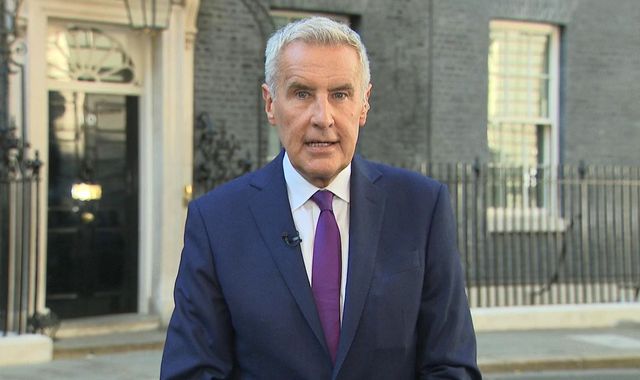
In a statement, his family said he died at his north London home on Saturday morning following a period of illness with prostate cancer.
“He died peacefully with his family at his side,” they added.
Murnaghan, 68, was a lead anchor for Sky News for 15 years until 2023. Before that, he presented the news for Channel 4, ITV and the BBC, and was also known and loved for hosting the popular quiz show Eggheads.
In a distinguished career in journalism spanning five decades, his was the voice of calm authority that broke the news of elections, wars and resignations, and the death of the Queen in 2022.
More recently, he had become known for fundraising and highlighting the importance of testing for prostate cancer, after being diagnosed towards the end of 2024.
His decision to speak so openly in the months before his death “will have saved lives”, said former prime minister David Cameron, who has also been treated for the disease.
Former head of Sky News John Ryley, who worked with Murnaghan throughout his time at Sky, joined Lord Cameron in paying tribute, saying the presenter was “absolutely the heart of Sky’s ability to break news”.
After starting out in local newspapers, Murnaghan went on to work for all the UK’s major news broadcasters – first at ITN with appearances on Channel 4 News and News At Ten, then moving to BBC News and the organisation’s Breakfast show, alongside co-host Natasha Kaplinsky, in the early 2000s.
Embracing the more relaxed format of breakfast television, his personality was able to shine – but the challenge of rolling news awaited.
He became a key face of Sky News, presenting various shows, including a Sunday morning politics programme, over the years.
Paying tribute to a “fantastic” friend and journalist, Ryley said one of his great strengths was “his ability to stay calm and lucid under intense pressure”.
He was also brilliant company, Ryley said. “He didn’t say very much, but when he did chat, what he said was golden, insightful, and clear, and on the money. And what I really liked about him – which is why he was a good journalist – is he didn’t like authority and he wasn’t shy of showing it.”
Sky News presenter Anna Botting, who worked alongside Murnaghan on such big events as the Queen’s funeral, said: “What Dermot brought to this craft of journalism was pinpoint accuracy.
“He was hugely conscientious – which brought out the detail of stories. And he was utterly fearless with politicians however erudite and articulate they were. He absolutely believed in holding authority to account.”
Honours throughout Murnaghan’s career included the Royal Television Society’s interviewer of the year award in 1999, and the newscaster of the year award from the Television & Radio Industries Club in 2000.
After leaving Sky News, he launched the Legends Of News podcast earlier in 2025, interviewing the likes of Sir Trevor McDonald, Jonathan Dimbleby and Kirsty Young.
It was not long after this he revealed the news of his stage-four prostate cancer diagnosis, speaking out to raise awareness of the importance of testing and early detection. He had fallen ill while on holiday abroad, returned home and received the diagnosis – “a real bolt from the blue”.
Alongside others with the same diagnosis, such as Sir Chris Hoy, he campaigned for a national screening programme and raised thousands of pounds for Prostate Cancer UK.
“Get the test, insist on the test,” Murnaghan said at a fundraising event for Prostate Cancer UK. “You can insist on the test if you are in a high-risk group and under 50. If you are not, I’d still get the test at 50.”
Paying tribute, Lord Cameron said the presenter’s decision to speak out and highlight the importance of PSA testing – to check the level of prostate specific antigen in the blood – will have helped many other men.
“I think it’s really important that Dermot came out in the way that he did – as in his broadcasting life, he did it with incredible clarity and just simplicity,” he said. “And as someone who was so well known to people through his broadcasting career over 40 years, it will have had a huge impact.
“He will have saved people’s lives because people will have heard him say that, they would have thought, ‘Okay I won’t put off the PSA test, I’ll go and ask for one, I’ll ask my doctor’.”
Outside his career in journalism and his campaigning, Murnaghan was an Arsenal fan and a keen cyclist. He leaves behind his wife, Maria, and four adult children.