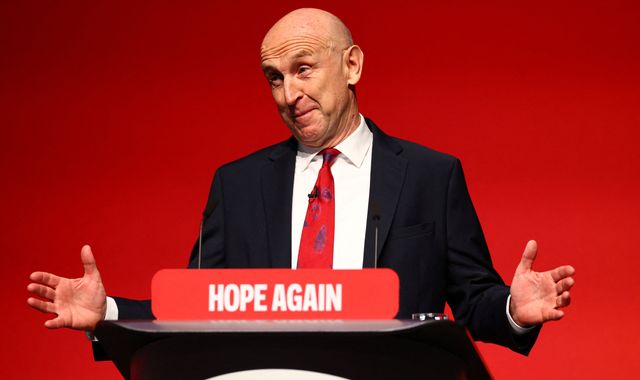
Sky News has learnt that the chief executives of lenders including Barclays, HSBC, Lloyds Banking Group and NatWest Group have been asked to attend a meeting with Mr Healey next Tuesday.
The bosses of Santander UK and Nationwide are also understood to have been invited to attend.
Money latest: The best fixed deals as energy price cap rises
It will be the first such in-person meeting that Mr Healey has held with UK bank chiefs since he replaced Rachel Reeves as chancellor in July, and will come ahead of his inaugural major fiscal event towards the end of the month.
In his speech to the Labour Party conference in Liverpool this week, Mr Healey pledged to work “in partnership with business and the unions”.
There are, however, growing fears in the banking industry that he will hike taxes on the industry by billions of pounds a year to fund spending commitments or tax cuts elsewhere.
Growing economic and geopolitical headwinds have sparked suggestions that the Treasury will accept a smaller fiscal buffer to facilitate lower tax rises in the budget.
Sector chiefs have embarked on a frenetic lobbying campaign to head off a tax raid, arguing that it will inhibit banks’ ability to finance growing companies and undermine Britain’s international competitiveness.
None of the banks contacted by Sky News on Thursday would comment, while the Treasury has been asked to comment.
Earlier this week, Sky News revealed that Revolut, Britain’s most valuable fintech, was among a pack of challenger banks urging the chancellor to remove the threat of an immediate tax raid on the sector in the budget.
A dozen of Britain’s mid-tier lenders to consumers and businesses signed a letter to Mr Healey calling on him to lift the threshold at which the corporation tax surcharge applied to banks kicks in from £100m to £500m.
The signatories also included Monzo, Paragon Bank and Shawbrook.
Unions have been calling on the chancellor to raise billions of pounds from the industry to fund government commitments elsewhere, amid a period of bumper profits for the UK’s biggest banks.
In their letter, the challengers said “any increase in the rate of the surcharge would have a significantly negative and disproportionate impact on mid-tier and specialist banks and harm investor sentiment in our sector”.
Although Mr Healey has not yet met the bosses of the UK’s biggest banks, he has held face-to-face talks with Jamie Dimon, the chairman and chief executive of JPMorgan Chase, who has raised the prospect of cancelling a major new UK headquarters if international banks are hit with higher UK taxes.
UK Finance, the trade association, has also written to Mr Healey to warn that imposing further tax rises on the banking sector would risk “damaging the UK’s international competitiveness”.
Bank lobbying against tax hikes has become a well-trodden path for executives in recent years as higher interest rates and declining provisions for misconduct have helped fuel industry profits
Britain has retained a number of bank-specific taxes – including the bank levy and surcharge – since the aftermath of the 2008 financial crisis which the sector has argued makes the country less competitive than those based in rival financial centres around the world.
Unlike other countries, the UK also retains a ring-fencing regime separating retail and investment banks which imposes significant costs on the big five lenders.
Under Rachel Reeves, Mr Healey’s predecessor, the Treasury began to reform ring-fencing rules, although the new chancellor has yet to express a view about whether that overhaul will proceed.