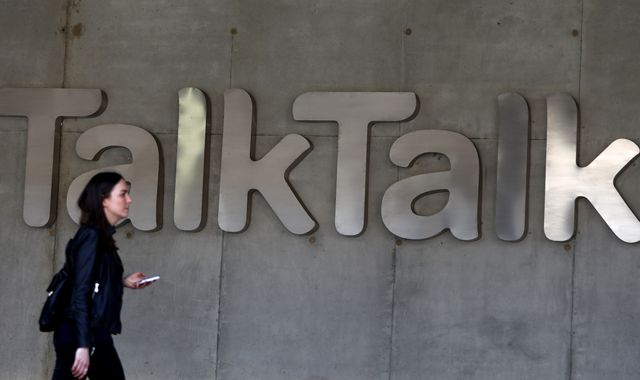
Lisa Nandy’s decision was revealed shortly after confirmation of a story by Sky News that BT had agreed a deal to buy TalkTalk out of administration.
The telecoms giant said it had stepped in to save TalkTalk and its wholesale PlatformX Communications (PXC) business from collapse in a “genuinely unprecedented situation” that could have impacted telecoms for 2.5 million customers.
Money latest: ‘HSBC error put me £6,000 in debt’
BT said the deal will “protect continuity of service for its 2.5 million customers, avoiding the risk of material harm to vulnerable customers and key emergency services”.
Administrators at Alvarez & Marsal Europe said the sale will see all 900 employees at TalkTalk’s consumer and broadband business and PXC transfer to BT.
Sky’s City editor Mark Kleinman, citing sources, reported that BT had agreed to pay roughly £100m to Ares Management – TalkTalk’s largest creditor – while investment firm KKR was expected to receive a payment in the region of £60m.
But the government said Ms Nandy, on news of the agreement, had taken “urgent action” under Enterprise Act powers to intervene, amid concerns that “any collapse of TalkTalk could cause sudden disruption to vital phone and broadband services, putting lives, public services and vulnerable customers at risk”.
The statement said the Competition and Markets Authority (CMA) had been asked to report back to her by 19 October.
TalkTalk was left with little option but to strike a deal with BT after the FTSE 100 company rejected a proposal from private equity firm Epiris relating to TalkTalk’s PXC division.
The pre-pack administration will leave other creditors owed hundreds of millions of pounds, which they are unlikely to recover.
Shareholders, including the founder Sir Charles Dunstone, will be wiped out.
He launched TalkTalk in 2004 with an audacious attempt to capture a big share of Britain’s retail telecoms market.
The company was floated on the London Stock Exchange in 2010, when it demerged from Carphone Warehouse, which Sir Charles also co-founded.
Its 2021 delisting took place at a valuation of about £2bn including debt.
The company has struggled for long periods since then, with cashflow difficulties – exacerbated by a haemorrhaging of its retail customer base – meaning the group’s valuation has shrunk significantly over the last five years.
This breaking news story is being updated and more details will be published shortly.
Please refresh the page for the fullest version.
You can receive Breaking News alerts on a smartphone or tablet via the Sky News App. You can also follow @SkyNews on X or subscribe to our YouTube channel to keep up with the latest news.