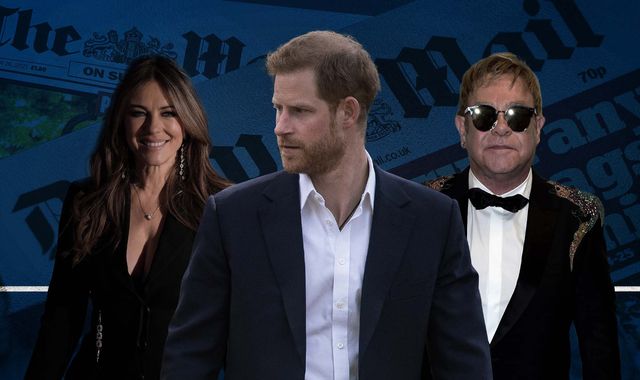
The Duke of Sussex and the other claimants, including Sir Elton John and Liz Hurley, allege Associated Newspapers Limited (ANL) hired private detectives to commit a series of unlawful acts between 1993 and 2011.
Harry took to the stand on Wednesday, opening up on his experiences with the media and appearing emotional as he recounted how the press “made my wife’s life misery”.
Hurley gave evidence the following day, also becoming tearful as she described the alleged “brutal invasion” of her privacy by the media.
Sir Elton and Baroness Doreen Lawrence are also expected to give evidence during the nine-week trial at London’s High Court, as well as several journalists and editors from ANL, including former Daily Mail editor Paul Dacre.
Here is everything you need to know.
What is the case about?
The allegations relate to more than 50 articles written between 1993 and 2011, which the claimants say were obtained through the unlawful gathering of information by the publisher, ranging from tapping their phones and bugging their homes to getting medical records by deception.
Fourteen of those articles relate to Harry – 13 are pictured below and an image for the 14th has not been provided to court.
The alleged unlawful acts include the publisher hiring private investigators (PIs) to secretly place listening devices inside cars and homes and paying police officials for inside information.
Lawyers for the claimants say there is “highly distressing” evidence revealing they had been victims of “abhorrent criminal activity” and “gross breaches of privacy” by ANL.
ANL – which publishes The Mail on Sunday and MailOnline – denies the allegations, describing them as “preposterous smears”, and claims the legal action is “a fishing expedition by [the] claimants and their lawyers”.
The publisher also says the claimants in the case had “leaky” social circles which allowed it to gather the information in its articles, and that the claims have been brought too late as they fall outside the statute of limitations – a law indicating privacy claims should be brought within six years.
The accusations include:
• The hiring of PIs to secretly place listening devices inside people’s cars and homes;
• The commissioning of individuals to surreptitiously listen to and record people’s live, private telephone calls while they were taking place;
• The payment of police officials, with corrupt links to PIs, for inside, sensitive information;
• The impersonation of individuals to obtain medical information from private hospitals, clinics, and treatment centres by deception;
• The accessing of bank accounts, credit histories and financial transactions through illicit means and manipulation.
The case began in 2022 and is just one of several Harry has filed against media organisations since 2019 regarding alleged breaches of privacy, unlawful practices and false stories.
Who else is involved?
Prince Harry is one of the key players. But as this is a group litigation, he is not the only claimant.
The others include:
David Sherborne is the lawyer representing all the claimants. The leading barrister represented Hollywood actor Johnny Depp in his UK libel case against the publisher of The Sun newspaper in 2020, and Coleen Rooney during the high-profile “Wagatha Christie” trial, brought by Rebekah Vardy, in 2022.
Harry’s late mother Princess Diana, Hollywood actor Michael Douglas and model Kate Moss are also among his previous clients.
What has Harry said in court?
Harry took to the stand on Wednesday, 21 January to give evidence in court, and was cross-examined by ANL’s legal team for about two-and-a-half hours.
He told the court: “I have never believed that my life is open season to be commercialised by these people.”
Twice during the hearing, Judge Nicklin politely reminded the duke that he did not “have to bear the burden of arguing the case”, but simply had to answer questions put to him. But Harry told him he had had a “bad experience” previously.
Responding after it was put to him that his social circles were “leaky”, Harry said he wanted to make it “absolutely clear” that they were not.
He said ANL had done “a very good job of stripping out all the colour from the situations the claimants have been in” and that stories about his private life were not in the public interest.
Harry’s written witness statement, in which he said he has had an “uneasy relationship” with the press since his mother Princess Diana’s death in 1997, was released to the court.
He said that he did not complain about articles written about him at the time “because of the institution I was in”.
“If you complain, they double down on you, in my experience,” he added.
It was right at the end of his evidence, as he mentioned his wife, Meghan, that he became emotional.
“They continue to come after me, they have made my wife’s life an absolute misery, my Lord,” he said, his voice faltering.
Hurley says phone tapping ‘crushed’ her
Hurley spent several hours in the witness box on Thursday, where she hit back at suggestions of leaks in her social circles.
The allegations in Hurley’s case relate to 15 articles published between 2002 and 2011.
She explained in front of Judge Nicklin how there had been an “avalanche” of articles written about her in the 2000s, and particularly after the birth of her son, Damian. Many were “unpleasant”, she told the court.
Hurley became tearful and wiped her eyes several times during her evidence, but each time said she wanted to carry on rather than taking a break.
“I felt really mortified that my son would be able to read all this stuff one day, and I feel really bad that that day is today when all this stuff is being regurgitated again,” Hurley said.
“Yet again, everyone’s privacy is being invaded in this terrible way, and I feel very helpless about that.”
Asked why she did not complain about the articles in her claim at the time they were published, Hurley said she had always thought “complaints were for libel” – and these stories “were in essence true”.
She continued: “I believe that is because people were listening to me speak.”
There were “microphones on the windowsill of my dining room” and her rooms and landlines were “bugged”, Hurley told the court.
She said the alleged tapping of her landline was a “brutal invasion of privacy” that left her feeling “crushed”.
What else has happened so far?
Proceedings began on Monday 19 January and are set to last a total of nine weeks.
You can keep up with the latest updates via Sky News’ live blog. Here’s a recap of more of what’s happened so far:
Opening statements
With Harry seated behind him, Mr Sherborne gave the first opening statement on 19 January, telling the court that ANL had overseen a “clear, systematic and sustained” use of unlawful information gathering.
He said they “knew they had skeletons in their closet” when they emphatically denied all claims of unlawful practices.
He described ANL’s denials as a “hear no evil, see no evil, speak no evil defence” and claimed the publishers had “stuck to their story” in repeatedly denying claims of unlawful information gathering and have “aggressively” repeated these denials.
He gave details of PIs, including one who says ANL staff knew information he gathered was obtained unlawfully and that they were his “best customers” for up to two years following his conviction for accessing information.
On Harry’s claim, Sherborne said the prince had experienced “distress” and “paranoia” caused by alleged unlawful information gathering and that he had “endured a sustained campaign of attacks against him” for having the temerity “to stand up to Associated in the way that he has so publicly done”.
On the second day, Anthony White KC laid out the defence for ANL, saying Daily Mail and Mail on Sunday journalists provide a “compelling account of a pattern of legitimate sourcing of articles”.
He said the claimants’ arguments about payments to PIs were “examples of clutching at straws in the wind”. They have accused ANL of spending more than £3m on PIs.
He told the court that ANL is “not a corner shop” and that it is audited – and “auditors usually do not miss the haemorrhaging of large amounts of cash of this size”.
He went on to mention one private investigator named in the case – Gavin Burrows – who, according to a 2021 statement, allegedly claimed to have hacked voicemails, tapped landlines, and accessed financial and medical information at the request of a journalist at the Mail on Sunday.
But the High Court heard that Mr Burrows later claimed his signature on the statement was forged.
Mr White said that the witness statement had “provided the only direct evidence of the most serious allegations of unlawful information gathering” and that the claims of Hurley, Sir Elton and Furnish in particular relied “heavily on the allegations made”.